The State of the Arts in 2026, and why local arts non-profits are the ones to lead the way forward.
If there is one thing that makes me a little bit queasy, it is seeing "First time reaction" videos from professionals in the arts.
If you don't know what I mean, because you are blessedly off-line, I'm referring to videos on Youtube where someone like a "Gen Z Music Producer" listens to, say, Elvis, or the Beatles, for the very first time.
As human beings, we take a lot of joy in seeing other people experience things we enjoy for the first time. We like showing people our favorite movies, television shows, songs, and we feel approved of and wise when they also enjoy it. That's why these videos are so popular.
But there is something very alarming about seeing professionals in music, who are well into their careers and into adulthood, who have never before listened to major, inescapable, cultural-touchstone artists.
It doesn't say anything about Gen Z. But it speaks volumes about the failure of popular culture in 2026.
When I was growing up, popular culture, in addition to being entertaining, brought a wealth of educational value. Oldies stations were on all of the time, and taught the masses music history. Movies used their soundtracks to set a time and place and give people a feel for what life was really like in the past. Popular television shows made reference to other pieces of art regularly, and expected their audience to either know those references, or be intrigued enough to go learn about them. We had arts and education channels devoted entirely to expanding our knowledge of the arts. MTV and VH1 regularly did retrospectives that expanded our knowledge--all while seemingly being pure entertainment.
Those stations and and channels turned into reality television. And then the internet took over our entertainment, and people became siloed in a loop that didn't expand their cultural knowledge, but instead boxed them into what they already knew and were familiar with. Taylor Swift is the biggest artist in the world, and possibly of all time--and yet, if you are not a Taylor Swift fan, it is possible to never hear a Taylor Swift song.
Not long ago at all (I'm only 41--a mere baby, I'm sure you'll agree), it would be quite impossible for a music producer to have never heard a Rolling Stones song. And if you said out loud that you hadn't, everyone else around you would say, "Do you live under a rock? How do you expect to produce music if you've never even listened to the greats?"
Our commercial arts picked up a tremendous amount of slack left by institutional arts education. But they are not picking up slack, anymore. And in many areas, arts education in schools has been a complete joke for a long time, and getting less funny every year. Where does that leave our upcoming and future generations when it comes to arts education?
We have completely underestimated the important role of pop culture in arts education. Now that the human connection (both to each other in the here and now, and to our past) has come to be seen as nothing more than an impediment to profit, as opposed to the reason and essence for people to come together (and spend money) in the first place, the business of popular culture has abdicated any responsibility towards arts education.
(Thank GOODNESS we live in Humboldt County, where radio with human dj's is still king. Get involved with KMUD if you aren't involved already!).
And if the human connection is an impediment to profit, then now is the time for non-profits to seize the responsibility and create a new popular culture.
But before we do, let's take a look at where our commercial institutions stand.
The Music Industry
I'm not entirely sure where to begin, the music industry is such a horrifying mess.
Suffice it to say, the labels are not interested in developing human talent (and certainly not paying human talent) anymore. Like every arts industry, this has been a long downward spiral for several decades, but with the rise of AI, we are seeing at last that the bottom goes all the way down, and this is not "business as usual."--Even if the business has always leaned towards "terrible."
The biggest record labels, like Universal, are getting out of development of artists entirely, and even acquisitions of catalogs (they basically already have all of them). To own more would make them a technical monopoly. And so they are getting out of the music business, and into AI licensing.
This lawyer explains it a little better (though I feel there may be a more elegant analogy out there than the one she uses). There's a longer video on her channel.
The major labels haven't been interested in seeking out and developing new talent in any kind of serious way in years. Mostly, they have been in the buying and selling of legacy catalogs. Now we see where that music is ending up: As food to train AI with.
What does this mean? It means a lot of things, but to put it as simply as possible: It means the future of the mainstream, international music business leaves human beings out entirely. And I mean entirely.
The tech industry is now the major distributors and manufacturers of music (and all other popular content). And their goals are not the advancement and spreading of the world's best musical artists. Their goal is to extract resources from artists, to train AI to be an art substitute (for many horrible reasons better dealt with in other articles).
There will be no value--no better understanding of humanity or broadening of perspective or deepening of education. We could say that we are already there, but we are not: The bottom goes all the way down. But we are approaching it fast.
In short: Big Music is over. It has merged with Big Tech.
The Movie Industry
In spite of the fact that Hollywood came out with some tremendous films in the past couple of years, after a couple of decades of nonstop Superhero franchises, Hollywood (or, to put a fine point on it, the American Movie Industry and all of the people who work in it) is still very much in trouble.
There are simply no jobs. Very little is filming in LA, or in the United States in general. You can actually see the downsizing happen in a YouTube scroll. Every sitcom actor is now a podcaster. Whereas they once did collaborative art with a collection of artists and technicians and presented their work to the public week after week, they now are reduced to sitting in a chair, alone, or with one other person, and simply talking into a microphone. No script, no set, no point, no show. They win Emmys for it.
Both the audience and the professionals suffer for this immense downgrade in the quality of our programming. And frankly, it's creepy, sad and demoralizing to watch.
Where a television program once involved things like foreshadowing, and metaphors embedded in the set and costumes, intricate plot points and jokes that played out like games and came back around--things that helped the viewer exercise their brains even in the silliest of comedies--now all of that has been stripped away in favor of, "Just sit there and say stuff. Anything. Whatever."
And it's deeply boring, to add insult to injury.
In the background, the major streaming and distribution companies are merging and buying each other. Just like the music industry, the game is amassing catalogs. For what purpose? You guessed it: Training AI. So that AI can continue to replace the human element.
Meanwhile, on Broadway...
Broadway is, quite simply, failing. They aren't making any money. They have not had a cultural smash hit since Hamilton. And the musicals on Broadway are not turning a profit.
(This is from a year ago, but we can expect it is still much the same).
Broadway relies on the human element. But with rising costs for rent and physical goods (which also increases the cost of labor), it's becoming impossible for them to continue. Musicals are expensive to produce, but they are also the most profitable thing the theatre has to offer. Musicals make all other theatre on Broadway possible.
But when costs soar out of control, and begin to outweigh what people can justify spending in ticket prices, the system collapses.
Broadway is still where many of our greatest performers and artists come into the public consciousness. As far as arts-for-profit are concerned, it's the last holdout on promoting human ingenuity, talent and perspective. And it has become unsustainable.
We can point to many culprits for the rising costs. But I'm more interested in which direction these rising costs will herd theatre producers.
First and foremost: It herds them towards getting out of the game entirely. Theatre requires money, and when the people with the money get out of the game, and the risks start to outweigh the rewards, and the cost to entry is prohibitive for anyone with less than established wealth, there is no one to replace these producers. Theatre stops being produced.
And secondly, if they stay in the game, it leads to looking for ways to replace the human element. Yes, it can and does happen in the theatre. Head to southern California and take a stroll down Hollywood Blvd, and you'll see theatres devoted to holographic recreations of old stars that you can see "live" in concert! Actors not required.
To devoted theatre goers, this may seem ridiculous, and like something no one would pay to see. But to the theatre tourist--which are the people that hold up Broadway--you want to see the neat things that are on offer, and that includes the holographic shows. They are a novelty. They are entertaining. And they are cheaper than the cast of a Broadway musical that runs in perpetuity. Today, having a Broadway smash hit also means having a lot of expenses for decades. Eliminating that expense is attractive, and doable, if you don't mind sacrificing everything about the theatre that makes it worthwhile. While theatre producers tend to be slightly more idealistic than, say, music moguls, and may scoff at ever producing such crap, the building owners will rent their space to producers willing and able to pay the rent for it. If they keep their rents high, those who seek nothing but profit will move in, and make their profit however they can.
To so many people, these things seem frivolous, or unimportant. But when a musical like Hamilton finds its way to some young person on the other side of the country, who listens and begins to marvel at what human beings are capable of, and develops an interest in the arts as a result (and in studying the human condition, and in being observant, and in understanding language and nuance better, etc, etc, etc), the arts have served a purpose in expanding human potential and promise.
What happens when we stop expanding human potential and promise?
I could go on and on (and have). This is only the tip of the iceberg of the ways in which the pop culture giants have abandoned their purpose and value, and the ways in which society is left bereft without them.
But luckily, we still have some levers we can pull to ensure that human arts and entertainment will persevere, along with all of the benefits and education they provide.
In fact...the arts may become stronger than ever...
Local Non Profit Arts Organizations Should Understand Their Importance and Responsibility in this Moment.
Nonprofits rely on donations to exist, and they MUST spend any "profit" on their mission. The mission is all. The profit incentive is removed. The mark of a well-funded theatre is one where everyone is paid, and the shows can be made intentionally and with the money needed to bring a show to fruition, as envisioned.
Nonprofits have their bugaboos, as well, and it's no secret that the best funded, most prominent arts institutions are beholden to their major donors, and that their nonprofit or foundation often functions as a way to white-wash unscrupulous money or power.
There is no artistic utopia.
But there are things we can do to move towards a more sustainable, less corruptible arts world. There are ways we can do things that don't allow what's most important to our communities to collapse under its own weight.
When community members support their local nonprofits, it removes the reliance on singular donors who make big donations. And then you have a nonprofit that sustains, and is not subject to political winds, trends, greed or profit motive. You have an organization that is only beholden to it's mission and the public their mission serves.
As the arts non-profits grow, local jobs and careers in the arts become possible, right where you live. Young people looking for attractive careers where they can practice their art no longer have to exclusively dream of being a content creator, where their art is dictated by algorithms, and is used to train AI. When the people commit to supporting their local arts organizations, young people can find opportunities where they live, and in more places than New York and LA, where life is cost prohibitive for an artist. They have an option to make art for the betterment of their community. Which is currently not something that is on the table for most artists, if they hope to earn an income.
Rural communities fail when the younger generations all leave and don't come back. Good, desirable jobs are almost always a major factor in choosing a place to live. If cities are interested in retaining billionaires and businesses, smaller cities, towns, and rural areas can seize the opportunity to make their towns attractive to young people with vision. This means taking seriously the need for thriving arts and culture that is home grown, investing in it.
The rise of AI plagiarized content (I cannot call it art) is entirely dependent on the inaccessibility of human made art. It depends on the rising costs of material goods, the rising costs of gas, the rising costs of rent and real estate. It depends on making even the most prominent artists of the 20th century buried underneath mountains of slop. It depends on a lack of arts education, and it depends on people not knowing there is something better, more beneficial, more enjoyable, and more meaningful out there: Connection with other people; stories told by artists that make you understand your own humanity better than you could alone.
The Boneyard Theatre Model
We structure the season very differently than traditional theatre seasons.
We make theatre every week (well...most weeks. We do require SOME time off).
We make it with the people who show up.
We make all of our shows free or low-cost.
We do not do auditions, but instead, have an extended series of open mic variety shows.
We continue the development of artists with readers theatre workshops that are open to the public, delving into scene work and the makings of a play.
As the season progresses, we move towards staging full productions.
Free or low cost theatre every single week, leading to a full production, giving the entire community the opportunity to participate, be an audience member, and learn about the process of theatre.
Rather than big blitzes of promotion around several spectacular shows, several months apart, we aim to make theatre a regular part of life in the community. Our goal is the development of new artists and theatre goers, creating a space for sustained artistic practice for anyone with a love for the arts, and creating innovative performances that reflect the lives of the people in our community. We want to be a home base for artists and in all mediums.
Our method allows for greater engagement and benefit to the community, and is thrillingly flexible in its scale. Boneyard Theatre can exist purely on people simply showing up, or it can lead the way in bringing theatre to underserved areas, in creating jobs in the arts, in creating arts education programs, and in creating thought provoking events that bring the entire community together.
So long as the community is involved, human arts will thrive. This is something we can build for ourselves, and keep as long as we want.
Nonprofits can make touring networks
If more theatres adopt a model that prizes sustainability and developing new artists, we can create a natural touring circuit for noteworthy performers to tour, while keeping costs reasonable to fans. What we have in such a scenario is an unbreakable, inclusive arts scenes that is accessible to people around the country (dare I say world) where the artists are in control of their own work, the human element is at the forefront, and tremendous amounts of money are not being pushed around before anything can get done. We can have a popular culture that does not actively subvert our education, but instead increases literacy and critical thinking, broadens perspective, and reveals what's possible. We can pick up the slack being left by the entertainment industry, that has abandoned its responsibility, and run with it.
So much is possible when communities take it upon themselves to build lasting infrastructure.
But before we tackle the world, we have to take care of home first.
The human element is always the most important.
Our theatre, as a baseline, requires two things: People who can show up every week, and a space to show up to.
We are so lucky to have Redwood Playhouse as a sponsor and producing partner. The Redwood Playhouse is a tremendously versatile space with great acoustics, and is low cost to the community. Our partnership ensures that we always have a space to perform.
But even the lowest cost theatre requires a few people on payroll, gas and some material goods.
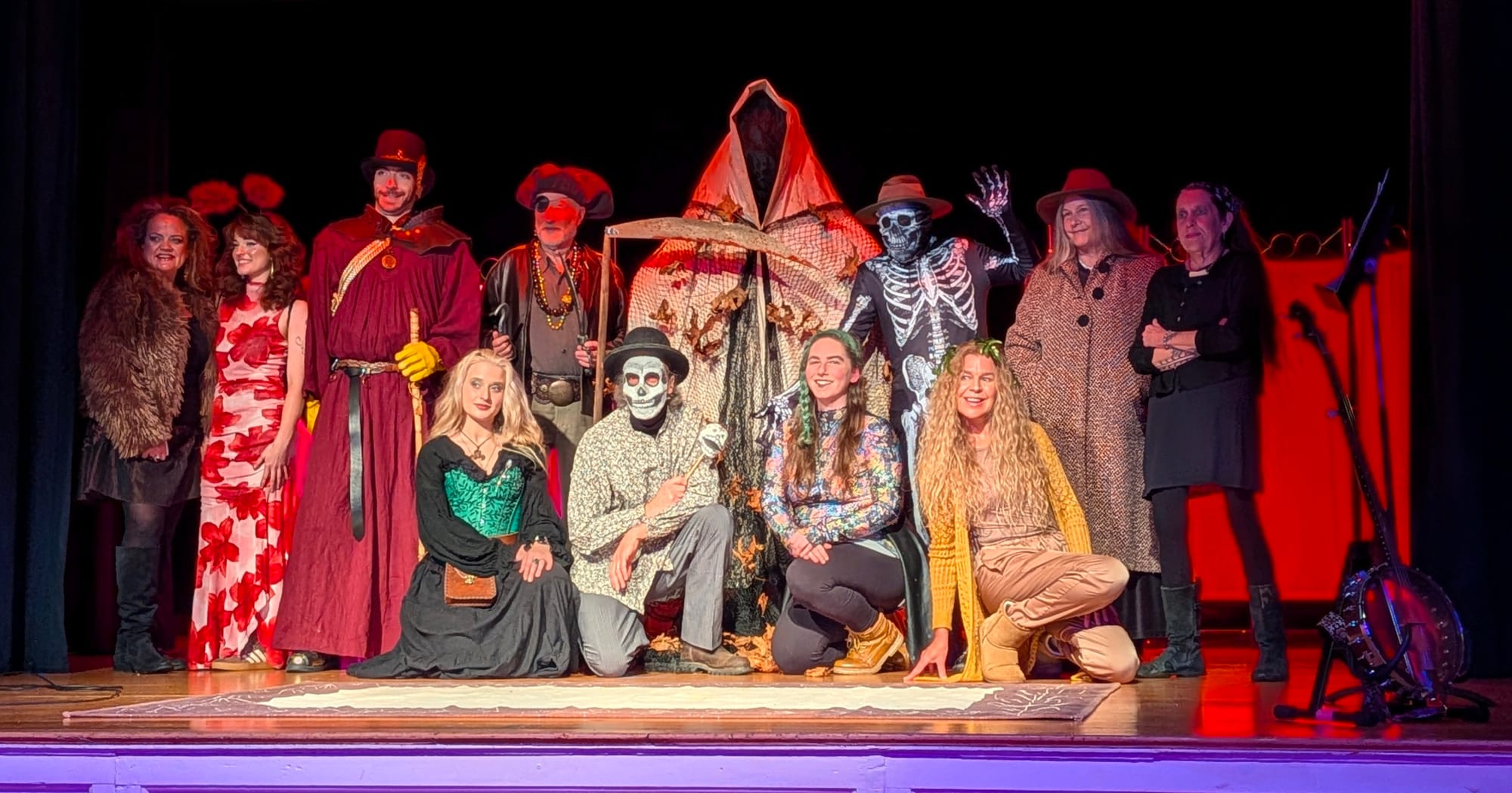
Boneyard Theatre is in its infancy, and has produced eight variety shows (Our "Sunday! Matinee! Open Mic! Cabaret!"(or SMOC) series,, which is still ongoing, and "A Halloween Holiday Cabaret!). On a budget of next to $0. Very close to $0. $0 is saying, "Don't stand so close to me."
And we are still going. Even as SMOC continues, we are gearing up for our Reading Shakespeare Series. All it takes is people showing up each week. And it turns out, when you give people the opportunity, spending a Sunday afternoon getting together and making entertainment for one another is something people want to come back to again, and again.
Our system is built on devotion, but devotion requires time, and time wants for wages.
The good news, there is no limit to the cost saving ingenuity of human beings. Give a theatre practitioner a cardboard box, and he will turn it into a castle that's fit for the stage. This is why human beings are the most worthy investment. Being able to bring in traveling artists, being able to fund the development of new work, being able to give a wage to our tireless volunteers--who could all be out trying to turn a buck– are the most crucial ways to invest in the sustainability of the theatre. This is how we keep showing up.
And printing. There's a lot of printing involved. That's also important to pay for.
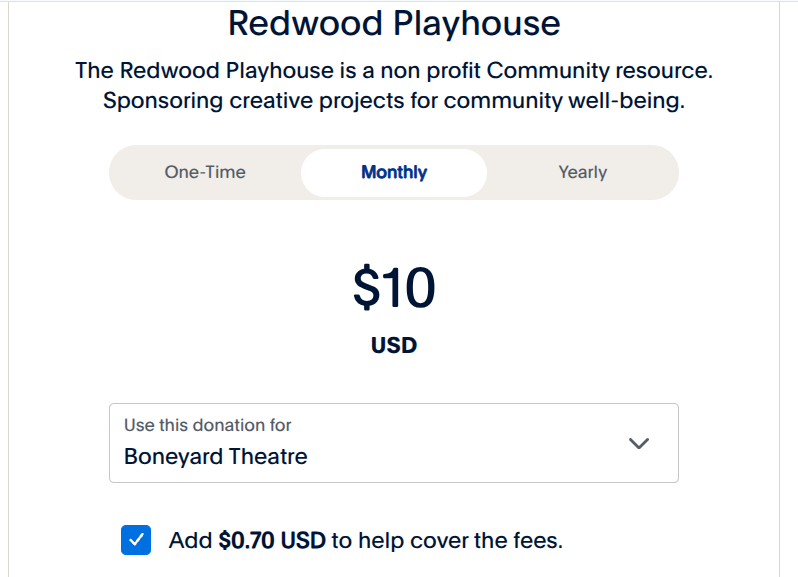
Becoming a monthly member at $10 a month is the best way to create an affordable, sustainable theatre that benefits the entire community.
Cheaper than a Netflix subscription, and more beneficial to the local economy. The only sure investment is the one you make in your community. Becoming a member enables us to budget and plan ahead, and truly make this a theatre that can sustain--far better than any single large donation could (And look, I'm not a monster. I'll take your large donation if it's really important to you!). We want to keep the monthly ask low enough that anyone can afford to feel part of the theatre, which creates so many benefits for the community, like increased literacy, reduced crime, greater spending at local businesses, and so much more.
We are looking for 150 people to become Founding Members of Boneyard Theatre at $10 or more a month (yes, you may donate more), or $120 a year. Your membership gets you access to every paid event for free, as well as surprise perks throughout the season.
But the biggest perk of all is that you allow us to give away most of our shows for free, and be a place where people can come together and share their stories, what they know, and all they are capable of--and do it in a way that endures.
Institutions may be crumbling. The world may be changing. But we aren't. We're still human. And we still have so much to share.
To become a member click here, or on the picture below, select Boneyard Theatre from the drop down menu, enter your monthly or yearly donation, and voila!
You just helped create an unbreakable arts and entertainment scene that puts the people first.
And make sure you subscribe to this newsletter so you can be up to date on everything going on at Boneyard Theatre. Our website, boneyardtheatre.com will also be of interest to you, but is also about to undergo a little revamp.
If you'd like to volunteer behind the scenes, please reach out to samantha@boneyardtheatre.com